Skip to content

Creator Record

Metadata

Related Records

  1. Negative
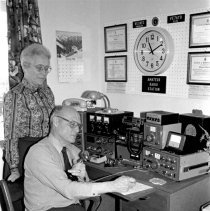
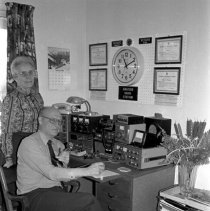
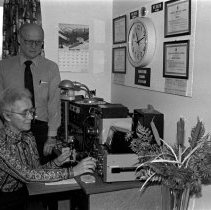
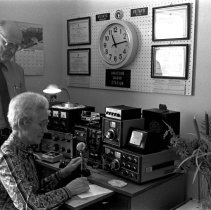
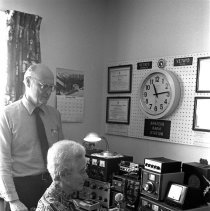
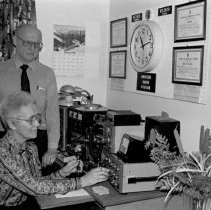
  2. P38536 - Preparing to send a radio broadcast from his home, at 78-1884 McCallum, is Charles Puhl of Clearbrook Seniors Amateur Radio Club. Listening in over her shoulder is her husband Charles. The two got their operating license at the same time, and had call letters that differ only by their final letter. Charles, president of the Clearbrook Seniors amateur Radio club, and fellow members agreed to be part of the Amateur Radio service - licensed amateur operators who volunteered to provide back-up communications service during any emergency situation. Telephone and electricity failures, and/or disasters such as earthquakes, railroad chemical spills, flooding, etc. were instance where such action might be required. The Amateur Radio Service formed part of the Ministry of Environment's Provincial Emergency Plan (PEP). The club had communications set up at MSA General Hospital and at Matsqui municipal hall as part of PEP. On the lighter side of the club's social service offerings, members had helped area residents contact relatives in New Guinea, Germany and other countries. For car rallies, bike-a-thons, distance runs and other community events, club members would take their portable equipment to various checkpoints along the route and set up a base station. Request for help for injured or exhausted participants, extra supplies such as juice, paper cups and band-aids, etc., would be transmitted to the base, which made the necessary arrangements. The club met every Wednesday at 7 p.m. at Clearbrook Community Centre. There were about 20 active members. The back bone of the group was formed by licensed radio operators, but there were operators who were not operators and attended only for the social atmosphere. The clubs call letters were VE7 CBA. Image not published.

    Record Type: Photo
    Negative
  3. P38537 - Preparing to send a radio broadcast from his home, at 78-1884 McCallum, is Charles Puhl of Clearbrook Seniors Amateur Radio Club. Listening in over her shoulder is her husband Charles. The two got their operating license at the same time, and had call letters that differ only by their final letter. Charles, president of the Clearbrook Seniors amateur Radio club, and fellow members agreed to be part of the Amateur Radio service - licensed amateur operators who volunteered to provide back-up communications service during any emergency situation. Telephone and electricity failures, and/or disasters such as earthquakes, railroad chemical spills, flooding, etc. were instance where such action might be required. The Amateur Radio Service formed part of the Ministry of Environment's Provincial Emergency Plan (PEP). The club had communications set up at MSA General Hospital and at Matsqui municipal hall as part of PEP. On the lighter side of the club's social service offerings, members had helped area residents contact relatives in New Guinea, Germany and other countries. For car rallies, bike-a-thons, distance runs and other community events, club members would take their portable equipment to various checkpoints along the route and set up a base station. Request for help for injured or exhausted participants, extra supplies such as juice, paper cups and band-aids, etc., would be transmitted to the base, which made the necessary arrangements. The club met every Wednesday at 7 p.m. at Clearbrook Community Centre. There were about 20 active members. The back bone of the group was formed by licensed radio operators, but there were operators who were not operators and attended only for the social atmosphere. The clubs call letters were VE7 CBA. Image not published.

    Record Type: Photo
    Negative
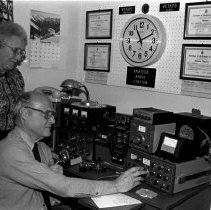
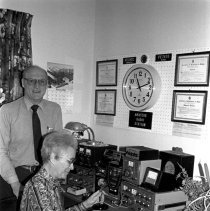
  4. P38538 - Preparing to send a radio broadcast from her home is Elma Puhl of Clearbrook Seniors Amateur Radio Club. Listening in over her shoulder is her husband Charles. The two got their operating license at the same time, and had call letters that differ only by their final letter. Charles, president of the Clearbrook Seniors amateur Radio club, and fellow members agreed to be part of the Amateur Radio service - licensed amateur operators who volunteered to provide back-up communications service during any emergency situation. Telephone and electricity failures, and/or disasters such as earthquakes, railroad chemical spills, flooding, etc. were instance where such action might be required. The Amateur Radio Service formed part of the Ministry of Environment's Provincial Emergency Plan (PEP). The club had communications set up at MSA General Hospital and at Matsqui municipal hall as part of PEP. On the lighter side of the club's social service offerings, members had helped area residents contact relatives in New Guinea, Germany and other countries. For car rallies, bike-a-thons, distance runs and other community events, club members would take their portable equipment to various checkpoints along the route and set up a base station. Request for help for injured or exhausted participants, extra supplies such as juice, paper cups and band-aids, etc., would be transmitted to the base, which made the necessary arrangements. The club met every Wednesday at 7 p.m. at Clearbrook Community Centre. There were about 20 active members. The back bone of the group was formed by licensed radio operators, but there were operators who were not operators and attended only for the social atmosphere. The clubs call letters were VE7 CBA. Image not published.

    Record Type: Photo

    Negative
  5. P38539 - Preparing to send a radio broadcast from her home is Elma Puhl of Clearbrook Seniors Amateur Radio Club. Listening in over her shoulder is her husband Charles. The two got their operating license at the same time, and had call letters that differ only by their final letter. Charles, president of the Clearbrook Seniors amateur Radio club, and fellow members agreed to be part of the Amateur Radio service - licensed amateur operators who volunteered to provide back-up communications service during any emergency situation. Telephone and electricity failures, and/or disasters such as earthquakes, railroad chemical spills, flooding, etc. were instance where such action might be required. The Amateur Radio Service formed part of the Ministry of Environment's Provincial Emergency Plan (PEP). The club had communications set up at MSA General Hospital and at Matsqui municipal hall as part of PEP. On the lighter side of the club's social service offerings, members had helped area residents contact relatives in New Guinea, Germany and other countries. For car rallies, bike-a-thons, distance runs and other community events, club members would take their portable equipment to various checkpoints along the route and set up a base station. Request for help for injured or exhausted participants, extra supplies such as juice, paper cups and band-aids, etc., would be transmitted to the base, which made the necessary arrangements. The club met every Wednesday at 7 p.m. at Clearbrook Community Centre. There were about 20 active members. The back bone of the group was formed by licensed radio operators, but there were operators who were not operators and attended only for the social atmosphere. The clubs call letters were VE7 CBA. Image not published.

    Record Type: Photo

    Negative
  6. P38540 - Preparing to send a radio broadcast from her home is Elma Puhl of Clearbrook Seniors Amateur Radio Club. Listening in over her shoulder is her husband Charles. The two got their operating license at the same time, and had call letters that differ only by their final letter. Charles, president of the Clearbrook Seniors amateur Radio club, and fellow members agreed to be part of the Amateur Radio service - licensed amateur operators who volunteered to provide back-up communications service during any emergency situation. Telephone and electricity failures, and/or disasters such as earthquakes, railroad chemical spills, flooding, etc. were instance where such action might be required. The Amateur Radio Service formed part of the Ministry of Environment's Provincial Emergency Plan (PEP). The club had communications set up at MSA General Hospital and at Matsqui municipal hall as part of PEP. On the lighter side of the club's social service offerings, members had helped area residents contact relatives in New Guinea, Germany and other countries. For car rallies, bike-a-thons, distance runs and other community events, club members would take their portable equipment to various checkpoints along the route and set up a base station. Request for help for injured or exhausted participants, extra supplies such as juice, paper cups and band-aids, etc., would be transmitted to the base, which made the necessary arrangements. The club met every Wednesday at 7 p.m. at Clearbrook Community Centre. There were about 20 active members. The back bone of the group was formed by licensed radio operators, but there were operators who were not operators and attended only for the social atmosphere. The clubs call letters were VE7 CBA. Image not published.

    Record Type: Photo

    Negative
  7. P38541 - Preparing to send a radio broadcast from her home is Elma Puhl of Clearbrook Seniors Amateur Radio Club. Listening in over her shoulder is her husband Charles. The two got their operating license at the same time, and had call letters that differ only by their final letter. Charles, president of the Clearbrook Seniors amateur Radio club, and fellow members agreed to be part of the Amateur Radio service - licensed amateur operators who volunteered to provide back-up communications service during any emergency situation. Telephone and electricity failures, and/or disasters such as earthquakes, railroad chemical spills, flooding, etc. were instance where such action might be required. The Amateur Radio Service formed part of the Ministry of Environment's Provincial Emergency Plan (PEP). The club had communications set up at MSA General Hospital and at Matsqui municipal hall as part of PEP. On the lighter side of the club's social service offerings, members had helped area residents contact relatives in New Guinea, Germany and other countries. For car rallies, bike-a-thons, distance runs and other community events, club members would take their portable equipment to various checkpoints along the route and set up a base station. Request for help for injured or exhausted participants, extra supplies such as juice, paper cups and band-aids, etc., would be transmitted to the base, which made the necessary arrangements. The club met every Wednesday at 7 p.m. at Clearbrook Community Centre. There were about 20 active members. The back bone of the group was formed by licensed radio operators, but there were operators who were not operators and attended only for the social atmosphere. The clubs call letters were VE7 CBA. Image not published.

    Record Type: Photo

    Negative
  8. P38542 - Preparing to send a radio broadcast from her home is Elma Puhl of Clearbrook Seniors Amateur Radio Club. Listening in over her shoulder is her husband Charles. The two got their operating license at the same time, and had call letters that differ only by their final letter. Charles, president of the Clearbrook Seniors amateur Radio club, and fellow members agreed to be part of the Amateur Radio service - licensed amateur operators who volunteered to provide back-up communications service during any emergency situation. Telephone and electricity failures, and/or disasters such as earthquakes, railroad chemical spills, flooding, etc. were instance where such action might be required. The Amateur Radio Service formed part of the Ministry of Environment's Provincial Emergency Plan (PEP). The club had communications set up at MSA General Hospital and at Matsqui municipal hall as part of PEP. On the lighter side of the club's social service offerings, members had helped area residents contact relatives in New Guinea, Germany and other countries. For car rallies, bike-a-thons, distance runs and other community events, club members would take their portable equipment to various checkpoints along the route and set up a base station. Request for help for injured or exhausted participants, extra supplies such as juice, paper cups and band-aids, etc., would be transmitted to the base, which made the necessary arrangements. The club met every Wednesday at 7 p.m. at Clearbrook Community Centre. There were about 20 active members. The back bone of the group was formed by licensed radio operators, but there were operators who were not operators and attended only for the social atmosphere. The clubs call letters were VE7 CBA. Image not published.

    Record Type: Photo

    Negative
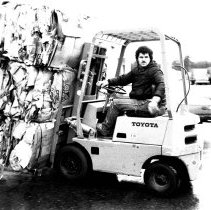
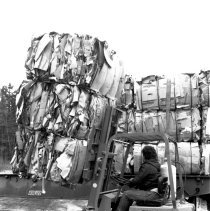
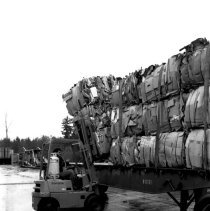
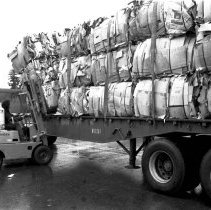
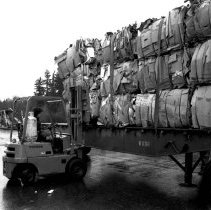
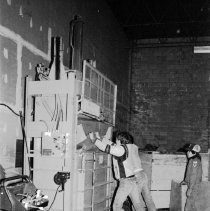
  9. P38555 - Loading baled cardboard for shipment is Gerry Wiebe, Community Enterprises workshop supervisor. Matsqui's landfill would have got an extra 100 tonnes of paper a month, in addition to the 500 tonnes it received at the time of this photo, if it was not for the Community Enterprises recycling operation of the non-profit Matsqui-Abbotsford Community Services. Those figures came from John Richards, manager of Community Enterprises and an appointee to the recycling committee of the Lower Mainland Refuse Project. He estimated that dump space saved by the recycled paper amounted to a "conservative 1,000 cubic yards." Community Enterprises also started collecting donated glass for recycling in January, and had been getting about eight tonnes a month-about 21 cubic yards. Richards stated that approximately 20 per cent of material going to Matsqui's landfill was paper and five per cent was glass. Since his appointment as manager when Community Enterprises was formed 18 months prior to the date of this photo, he had been trying to make it into a cost-effective business as well as a training ground for people who were physically disabled or at a disadvantage in obtaining employment. Moreover, Community Enterprise received a lot of community support-more than $12,000 worth from its inception. The donations included a truck from Emmanuel Mennonite Church, a forklift from Abbotsford Lions Club, a paper shredder from Rotary Club of Abbotsford, a baler from Pacific Coast Manufacturing and operating equipment from Ritchie and Abbotsford Eagles. With the aid of the community and Gerry Wiebe, 22, Richards felt they had achieved the goals they set out-and in some areas, exceeded them. Image not published.

    Record Type: Photo

    Negative
  10. P38556 - Loading baled cardboard for shipment is Gerry Wiebe, Community Enterprises workshop supervisor. Matsqui's landfill would have got an extra 100 tonnes of paper a month, in addition to the 500 tonnes it received at the time of this photo, if it was not for the Community Enterprises recycling operation of the non-profit Matsqui-Abbotsford Community Services. Those figures came from John Richards, manager of Community Enterprises and an appointee to the recycling committee of the Lower Mainland Refuse Project. He estimated that dump space saved by the recycled paper amounted to a "conservative 1,000 cubic yards." Community Enterprises also started collecting donated glass for recycling in January, and had been getting about eight tonnes a month-about 21 cubic yards. Richards stated that approximately 20 per cent of material going to Matsqui's landfill was paper and five per cent was glass. Since his appointment as manager when Community Enterprises was formed 18 months prior to the date of this photo, he had been trying to make it into a cost-effective business as well as a training ground for people who were physically disabled or at a disadvantage in obtaining employment. Moreover, Community Enterprise received a lot of community support-more than $12,000 worth from its inception. The donations included a truck from Emmanuel Mennonite Church, a forklift from Abbotsford Lions Club, a paper shredder from Rotary Club of Abbotsford, a baler from Pacific Coast Manufacturing and operating equipment from Ritchie and Abbotsford Eagles. With the aid of the community and Gerry Wiebe, 22, Richards felt they had achieved the goals they set out-- and in some areas, exceeded them.

    Record Type: Photo

    Negative
  11. P38557 - Loading baled cardboard for shipment is Gerry Wiebe, Community Enterprises workshop supervisor. Matsqui's landfill would have got an extra 100 tonnes of paper a month, in addition to the 500 tonnes it received at the time of this photo, if it was not for the Community Enterprises recycling operation of the non-profit Matsqui-Abbotsford Community Services. Those figures came from John Richards, manager of Community Enterprises and an appointee to the recycling committee of the Lower Mainland Refuse Project. He estimated that dump space saved by the recycled paper amounted to a "conservative 1,000 cubic yards." Community Enterprises also started collecting donated glass for recycling in January, and had been getting about eight tonnes a month-about 21 cubic yards. Richards stated that approximately 20 per cent of material going to Matsqui's landfill was paper and five per cent was glass. Since his appointment as manager when Community Enterprises was formed 18 months prior to the date of this photo, he had been trying to make it into a cost-effective business as well as a training ground for people who were physically disabled or at a disadvantage in obtaining employment. Moreover, Community Enterprise received a lot of community support-more than $12,000 worth from its inception. The donations included a truck from Emmanuel Mennonite Church, a forklift from Abbotsford Lions Club, a paper shredder from Rotary Club of Abbotsford, a baler from Pacific Coast Manufacturing and operating equipment from Ritchie and Abbotsford Eagles. With the aid of the community and Gerry Wiebe, 22, Richards felt they had achieved the goals they set out -- and in some areas, exceeded them. Image not published.

    Record Type: Photo

    Negative
  12. P38558 - Loading baled cardboard for shipment is Gerry Wiebe, Community Enterprises workshop supervisor. Matsqui's landfill would have got an extra 100 tonnes of paper a month, in addition to the 500 tonnes it received at the time of this photo, if it was not for the Community Enterprises recycling operation of the non-profit Matsqui-Abbotsford Community Services. Those figures came from John Richards, manager of Community Enterprises and an appointee to the recycling committee of the Lower Mainland Refuse Project. He estimated that dump space saved by the recycled paper amounted to a "conservative 1,000 cubic yards." Community Enterprises also started collecting donated glass for recycling in January, and had been getting about eight tonnes a month-about 21 cubic yards. Richards stated that approximately 20 per cent of material going to Matsqui's landfill was paper and five per cent was glass. Since his appointment as manager when Community Enterprises was formed 18 months prior to the date of this photo, he had been trying to make it into a cost-effective business as well as a training ground for people who were physically disabled or at a disadvantage in obtaining employment. Moreover, Community Enterprise received a lot of community support-more than $12,000 worth from its inception. The donations included a truck from Emmanuel Mennonite Church, a forklift from Abbotsford Lions Club, a paper shredder from Rotary Club of Abbotsford, a baler from Pacific Coast Manufacturing and operating equipment from Ritchie and Abbotsford Eagles. With the aid of the community and Gerry Wiebe, 22, Richards felt they had achieved the goals they set out -- and in some areas, exceeded them. Image not published.

    Record Type: Photo

    Negative
  13. P38559 - Loading baled cardboard for shipment is Gerry Wiebe, Community Enterprises workshop supervisor. Matsqui's landfill would have got an extra 100 tonnes of paper a month, in addition to the 500 tonnes it received at the time of this photo, if it was not for the Community Enterprises recycling operation of the non-profit Matsqui-Abbotsford Community Services. Those figures came from John Richards, manager of Community Enterprises and an appointee to the recycling committee of the Lower Mainland Refuse Project. He estimated that dump space saved by the recycled paper amounted to a "conservative 1,000 cubic yards." Community Enterprises also started collecting donated glass for recycling in January, and had been getting about eight tonnes a month-about 21 cubic yards. Richards stated that approximately 20 per cent of material going to Matsqui's landfill was paper and five per cent was glass. Since his appointment as manager when Community Enterprises was formed 18 months prior to the date of this photo, he had been trying to make it into a cost-effective business as well as a training ground for people who were physically disabled or at a disadvantage in obtaining employment. Moreover, Community Enterprise received a lot of community support-more than $12,000 worth from its inception. The donations included a truck from Emmanuel Mennonite Church, a forklift from Abbotsford Lions Club, a paper shredder from Rotary Club of Abbotsford, a baler from Pacific Coast Manufacturing and operating equipment from Ritchie and Abbotsford Eagles. With the aid of the community and Gerry Wiebe, 22, Richards felt they had achieved the goals they set out -- and in some areas, exceeded them. Image not published.

    Record Type: Photo

    Negative
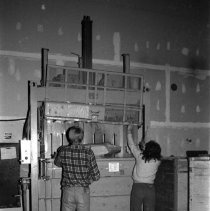
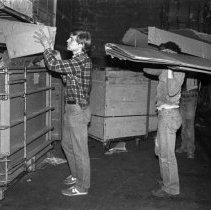
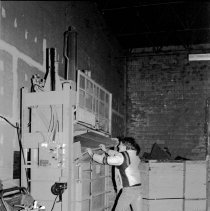
  14. P38560 - Baling cardboard for recycling is one part of an operation through which these workers at Community Enterprises keep about 100 extra tonnes of paper out of Matsqui's landfill each month. Those figures came from John Richards, manager of Community Enterprises and an appointee to the recycling committee of the Lower Mainland Refuse Project. He estimated that dump space saved by the recycled paper amounted to a "conservative 1,000 cubic yards." Community Enterprises also started collecting donated glass for recycling in January, and had been getting about eight tonnes a month-about 21 cubic yards. Richards stated that approximately 20 per cent of material going to Matsqui's landfill was paper and five per cent was glass. Since his appointment as manager when Community Enterprises was formed 18 months prior to the date of this photo, he had been trying to make it into a cost-effective business as well as a training ground for people who were physically disabled or at a disadvantage in obtaining employment. Moreover, Community Enterprise received a lot of community support-more than $12,000 worth from its inception. The donations included a truck from Emmanuel Mennonite Church, a forklift from Abbotsford Lions Club, a paper shredder from Rotary Club of Abbotsford, a baler from Pacific Coast Manufacturing and operating equipment from Ritchie and Abbotsford Eagles. With the aid of the community and workshop supervisor Gerry Wiebe, 22, Richards felt they had achieved the goals they set out-and in some areas, exceeded them. Image not published.

    Record Type: Photo

    Negative
  15. P38561 - Baling cardboard for recycling is one part of an operation through which these workers at Community Enterprises keep about 100 extra tonnes of paper out of Matsqui's landfill each month. Those figures came from John Richards, manager of Community Enterprises and an appointee to the recycling committee of the Lower Mainland Refuse Project. He estimated that dump space saved by the recycled paper amounted to a "conservative 1,000 cubic yards." Community Enterprises also started collecting donated glass for recycling in January, and had been getting about eight tonnes a month-about 21 cubic yards. Richards stated that approximately 20 per cent of material going to Matsqui's landfill was paper and five per cent was glass. Since his appointment as manager when Community Enterprises was formed 18 months prior to the date of this photo, he had been trying to make it into a cost-effective business as well as a training ground for people who were physically disabled or at a disadvantage in obtaining employment. Moreover, Community Enterprise received a lot of community support-more than $12,000 worth from its inception. The donations included a truck from Emmanuel Mennonite Church, a forklift from Abbotsford Lions Club, a paper shredder from Rotary Club of Abbotsford, a baler from Pacific Coast Manufacturing and operating equipment from Ritchie and Abbotsford Eagles. With the aid of the community and workshop supervisor Gerry Wiebe, 22, Richards felt they had achieved the goals they set out-and in some areas, exceeded them.

    Record Type: Photo

    Negative
  16. P38562 - Baling cardboard for recycling is one part of an operation through which these workers at Community Enterprises keep about 100 extra tonnes of paper out of Matsqui's landfill each month. Those figures came from John Richards, manager of Community Enterprises and an appointee to the recycling committee of the Lower Mainland Refuse Project. He estimated that dump space saved by the recycled paper amounted to a "conservative 1,000 cubic yards." Community Enterprises also started collecting donated glass for recycling in January, and had been getting about eight tonnes a month-about 21 cubic yards. Richards stated that approximately 20 per cent of material going to Matsqui's landfill was paper and five per cent was glass. Since his appointment as manager when Community Enterprises was formed 18 months prior to the date of this photo, he had been trying to make it into a cost-effective business as well as a training ground for people who were physically disabled or at a disadvantage in obtaining employment. Moreover, Community Enterprise received a lot of community support-more than $12,000 worth from its inception. The donations included a truck from Emmanuel Mennonite Church, a forklift from Abbotsford Lions Club, a paper shredder from Rotary Club of Abbotsford, a baler from Pacific Coast Manufacturing and operating equipment from Ritchie and Abbotsford Eagles. With the aid of the community and workshop supervisor Gerry Wiebe, 22, Richards felt they had achieved the goals they set out-and in some areas, exceeded them. Image not published.

    Record Type: Photo

    Negative
  17. P38563 - Baling cardboard for recycling is one part of an operation through which these workers at Community Enterprises keep about 100 extra tonnes of paper out of Matsqui's landfill each month. Those figures came from John Richards, manager of Community Enterprises and an appointee to the recycling committee of the Lower Mainland Refuse Project. He estimated that dump space saved by the recycled paper amounted to a "conservative 1,000 cubic yards." Community Enterprises also started collecting donated glass for recycling in January, and had been getting about eight tonnes a month-about 21 cubic yards. Richards stated that approximately 20 per cent of material going to Matsqui's landfill was paper and five per cent was glass. Since his appointment as manager when Community Enterprises was formed 18 months prior to the date of this photo, he had been trying to make it into a cost-effective business as well as a training ground for people who were physically disabled or at a disadvantage in obtaining employment. Moreover, Community Enterprise received a lot of community support-more than $12,000 worth from its inception. The donations included a truck from Emmanuel Mennonite Church, a forklift from Abbotsford Lions Club, a paper shredder from Rotary Club of Abbotsford, a baler from Pacific Coast Manufacturing and operating equipment from Ritchie and Abbotsford Eagles. With the aid of the community and workshop supervisor Gerry Wiebe, 22, Richards felt they had achieved the goals they set out-and in some areas, exceeded them. Image not published.

    Record Type: Photo

    Negative
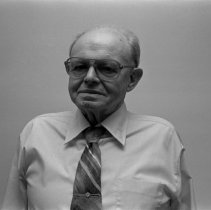
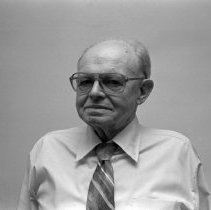
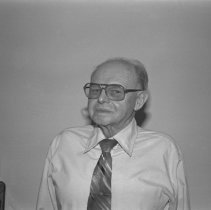
  18. P38593 - Peter Martens, retiring disaster service chairman of the Matsqui-Abbotsford Branch of the Red Cross. After 70 years of work with the Red Cross, spanning a revolution, an influx of refugees and a flood, Peter Martens retired from volunteer work with the organization. "I'm hitting 80, and it's time to let the younger ones do something," he told the ASM News. Martens, of Clearbrook, was born and spent his childhood in southern Russia. His interest in the Red Cross was kindled in 1914 when his father was drafter and became warehouse manager for the 'southwest front' which stretched from north Poland to Afghanistan. Martens was 10 years old and children were asked to separate threads from woven clothes to make bandages for soldiers. In his mid-teens, he had a close brush with death during the Russian Revolution. Drunken soldiers stood him in a corner of the home and shot within inches of his head. In another incident, soldiers set his father's coat on fire while the man was wearing it. The family left for Canada in 1925, and lived in various Prairie locations. In 1928, Peter married Barbara Janzen and they settled in Coaldale, Alberta, where he took the St. John's Ambulance course. In 1942, Peter and Barbara moved to Arnold to farm. Peter also worked for Clearbrook Frozen Foods as a field supervisor. Peter took another first aid course here in the Fraser Valley, and they later hosted a course in their home. When the Red Cross needed blood, "we rounded up a truck full of people" and took them to Abbotsford's blood donor clinic, he said. During the 1948 flood, the Martens used their home as a Red Cross dispatch centre. Barbara and their daughter were on the telephone continually. From Arnold, three shifts of 12 men each were at the Vedder River dyke around the clock. After the dyke broke, Peter was asked to check on two RCMP officers who had gone out with a rowboat to look in on the flooded Matsqui Prairie homes. He found them - with a man, his extremely heavy wife, a dog, two cats and a canary in their boat. In 1957, Peter became Red Cross Disaster Service chairman - a post which he held for 27 years. During the first year and a half of his chairmanship, about 6,000 Hungarian refugees went through a camp at Abbotsford Airport. He ran a depot which sorted and distributed donated clothing and household goods. From 1957 to 1976, the disaster service helped the victims of 39 house fires with clothing and bedding. From 1976 until his resignation, Peter saved the Red Cross money by obtaining supplies for the Red Cross from Mennonite Central Committee, stores and willing organizations. Peter was not retiring completely from volunteer work - he retained responsibility for Clearbrook Mennonite Brethren Church's radio broadcast, a job he had been doing for about 10 years. Image not published.

    Record Type: Photo

    Negative
  19. P38594 - Peter Martens, retiring disaster service chairman of the Matsqui-Abbotsford Branch of the Red Cross. After 70 years of work with the Red Cross, spanning a revolution, an influx of refugees and a flood, Peter Martens retired from volunteer work with the organization. "I'm hitting 80, and it's time to let the younger ones do something," he told the ASM News. Martens, of Clearbrook, was born and spent his childhood in southern Russia. His interest in the Red Cross was kindled in 1914 when his father was drafter and became warehouse manager for the 'southwest front' which stretched from north Poland to Afghanistan. Martens was 10 years old and children were asked to separate threads from woven clothes to make bandages for soldiers. In his mid-teens, he had a close brush with death during the Russian Revolution. Drunken soldiers stood him in a corner of the home and shot within inches of his head. In another incident, soldiers set his father's coat on fire while the man was wearing it. The family left for Canada in 1925, and lived in various Prairie locations. In 1928, Peter married Barbara Janzen and they settled in Coaldale, Alberta, where he took the St. John's Ambulance course. In 1942, Peter and Barbara moved to Arnold to farm. Peter also worked for Clearbrook Frozen Foods as a field supervisor. Peter took another first aid course here in the Fraser Valley, and they later hosted a course in their home. When the Red Cross needed blood, "we rounded up a truck full of people" and took them to Abbotsford's blood donor clinic, he said. During the 1948 flood, the Martens used their home as a Red Cross dispatch centre. Barbara and their daughter were on the telephone continually. From Arnold, three shifts of 12 men each were at the Vedder River dyke around the clock. After the dyke broke, Peter was asked to check on two RCMP officers who had gone out with a rowboat to look in on the flooded Matsqui Prairie homes. He found them - with a man, his extremely heavy wife, a dog, two cats and a canary in their boat. In 1957, Peter became Red Cross Disaster Service chairman - a post which he held for 27 years. During the first year and a half of his chairmanship, about 6,000 Hungarian refugees went through a camp at Abbotsford Airport. He ran a depot which sorted and distributed donated clothing and household goods. From 1957 to 1976, the disaster service helped the victims of 39 house fires with clothing and bedding. From 1976 until his resignation, Peter saved the Red Cross money by obtaining supplies for the Red Cross from Mennonite Central Committee, stores and willing organizations. Peter was not retiring completely from volunteer work - he retained responsibility for Clearbrook Mennonite Brethren Church's radio broadcast, a job he had been doing for about 10 years. Image not published.

    Record Type: Photo

    Negative
  20. P38595 - Peter Martens, retiring disaster service chairman of the Matsqui-Abbotsford Branch of the Red Cross. After 70 years of work with the Red Cross, spanning a revolution, an influx of refugees and a flood, Peter Martens retired from volunteer work with the organization. "I'm hitting 80, and it's time to let the younger ones do something," he told the ASM News. Martens, of Clearbrook, was born and spent his childhood in southern Russia. His interest in the Red Cross was kindled in 1914 when his father was drafter and became warehouse manager for the 'southwest front' which stretched from north Poland to Afghanistan. Martens was 10 years old and children were asked to separate threads from woven clothes to make bandages for soldiers. In his mid-teens, he had a close brush with death during the Russian Revolution. Drunken soldiers stood him in a corner of the home and shot within inches of his head. In another incident, soldiers set his father's coat on fire while the man was wearing it. The family left for Canada in 1925, and lived in various Prairie locations. In 1928, Peter married Barbara Janzen and they settled in Coaldale, Alberta, where he took the St. John's Ambulance course. In 1942, Peter and Barbara moved to Arnold to farm. Peter also worked for Clearbrook Frozen Foods as a field supervisor. Peter took another first aid course here in the Fraser Valley, and they later hosted a course in their home. When the Red Cross needed blood, "we rounded up a truck full of people" and took them to Abbotsford's blood donor clinic, he said. During the 1948 flood, the Martens used their home as a Red Cross dispatch centre. Barbara and their daughter were on the telephone continually. From Arnold, three shifts of 12 men each were at the Vedder River dyke around the clock. After the dyke broke, Peter was asked to check on two RCMP officers who had gone out with a rowboat to look in on the flooded Matsqui Prairie homes. He found them - with a man, his extremely heavy wife, a dog, two cats and a canary in their boat. In 1957, Peter became Red Cross Disaster Service chairman - a post which he held for 27 years. During the first year and a half of his chairmanship, about 6,000 Hungarian refugees went through a camp at Abbotsford Airport. He ran a depot which sorted and distributed donated clothing and household goods. From 1957 to 1976, the disaster service helped the victims of 39 house fires with clothing and bedding. From 1976 until his resignation, Peter saved the Red Cross money by obtaining supplies for the Red Cross from Mennonite Central Committee, stores and willing organizations. Peter was not retiring completely from volunteer work - he retained responsibility for Clearbrook Mennonite Brethren Church's radio broadcast, a job he had been doing for about 10 years. Image not published.

    Record Type: Photo

    Negative

Thank You!

Confirmation Message Here....